Sunday, June 10, 2012

Monks, Murals and Memories

Walled Monastery
Saturday and Sunday, 9, 10 June, 2012

Carpathians: No Wolves in Sight
Bucovina County, Romania
We were awakened today at just after midnight by a barage of fireworks from down the rural valley where we were spending the night-- one of the many Saturday weddings that take place in rural villlages.  This far north eastern corner of the country's claim to tourist fame are the many 14th Century monasteries that are part of the Eastern Orthodox Church.  Though some shelter within fortress-like walls, relatively simple on the outside, but heavily adorned with icons and gilt within, others are painted in rioutous colors and psychedelic murals inside and out.  With their high domed windows, I was cuirous about their orientation.  Conveniently, Jane's walking stick had a compass in the top, and it was clear that the buildings were on an East-West axis, with altars against the East wall.  Arriving on Sunday morning at a remote and active monastery, we listened to monks sing, and watched women with babushkas wait their turn to worhsip till after ALL the men were done.  Between the wall painting and the length of the service you get the feeling the monks had a lot of time on their hands in the middle ages.


 Outside of Painted Monastery
Painted monastery.... won't rotate!
We puzzled over some of the symbols in the paintings, and wondered how both the buildings and the religious practice survived both WW II and the Soviets.  At Putna, we could look across the border into the Ukraine.  At Dragomina, we were almost to the edge of Transnistria, a no man's land into which so much of the regions Jewish population were taken.  For Jane, it is difficult to look at aging train tracks and 75 year old train crossings, or to look into people's faces without thinking about family.

Does anyone know who invented the story of storks and babies?  There are stork nests on lamposts in every village, with mom and dad tending the newbies.  Though Gail persists in calling them pelicans, you can easily see the difference.

this won't rotate either!
Needless to say, we continue eatting our way across the country.  Fresh trout, wild mushrooms, stuffed cabbage and lots of polenta.


Eating Our Way Through Romania


Friday, June 8, 2012

Get Your Motor Running...... (staying) on the road!

Friday, 8 June 2012

Jane's white knuckles; horse cart
We loaded the blue Ford Focus rental, Jane got behind the wheel, Gail took over as navigator and Jeanne made the sign of the cross as we headed out of Oradea, bound for the mountains.  A relatively easy departure gave way to the Romanian version of the Indy 500, as Jane learned the rules of the road.  Dire predictions of car eating pot holes, bucolic bandits and maurading gypsies did not materialize, but the true meaning of defensive driving certainly did.  Jane's experience with both Colorado Rocky Mt highs and Aussie roundabouts served us well as she figured out when to move right into the shoulder/right lane and when to flash left signals and go like hell.  Some small differences between Romania and universal rural road driving included one lane bridges with double horse carts coming from the opposite direction. 


Jane and Gail decline menudo..at first
Tin roof on new construction
We stopped halfway for a light lunch, but there is no such thing in this country.  The delightful owner of a restaurant/pension encouraged us to try the house speciality ciorba de burta (known to us as menudo) but we all refused.  After finishing bowls of soup, polenta and platters of pickles, she cleared the table and then brought us a bowl of burta.  We were going to try it, or else!  It was wonderful. 


Valentin

Passed through the city of Bistrita, made it to the other side and checked in at the Sherrif Motel, not to be confused with the Old Sherrif Hotel next door.  We were the only folks there as we checked in, and selected our room just as Valentin, a photographer for a  Romanian travel site (www.bookingnow.ro) arrived to take photos of the hotel's rooms.  As we chatted about our various travels, he offered to show us pictures of some of the places we were planning to visit and might plan to visit, so we joined him in the lounge for our own private virtual journey.  We talked about old traditions in the north of the country.... when a family has a young daughter they decorate a bare trees with colorful pots.  When the daughter is finally of an age to marry, all the pots are red, and that's how you know!  Went on to religion, and skirted poltics, which would have taken the whole evening.  As we sat, the empty hotel filled with two busloads of Italian and Romanian kids on an intercultural excursion.  Though it could be a long night, we thank Valentin for a great afternoon.

Thursday, June 7, 2012

Lions of Judah

Thursday, 7 June 2012
There are 700 people in the Jewish community of Oradea (Or-AH-di-ah); all that remains of the 25,000 souls who lived, worked, and worshipped here before the war.  It was the 2nd largest Jewish community in Romania, with 29 synagogues in the city.  We visited one still remaining today with Emi, a new friend and kindred spirit Jane made contact with before leaving Australia.  Emi took us first to see the park where the death trains departed, carrying adults and children to Auschwitz and other labor camps.  Most had first been moved to a large ghetto which was surrounded by a tall stockade fence.  Of these, 2500 returned at the end of the war, but only a small number remained here.

Emi

Detail on home once owned by Jewish Families
Synagogue

Like Jane's father Simon, Emi speaks both Hungarian and Romanian, reflecting the region's history.  Simon was born near here, and as we visited the synagogue, built in the 19th century, we all wondered if he and his parents had also been there.  In the short time we spent with Emi she described the work she does with her organization, TIKVAH (www.tikvah.ro) Describing the group as "united in diversity" she is dedicated to not just remembering all that happened to the people here, but also reminding people of the normalcy of their lives and the contributions that they made to the culture and society of prewar Oradea.  She also wants to remember those, including parts of the Catholic community, who tried to help keep people alive.
Emi and Jeanne contmplate humanity
With this in mind, we made a stop at the Catholic cathedral, where the bishop at the time created predated baptismal records for some of the Jewish children.  As we approached the church, bells rang out, and we spent a few moments listening to organ and choir singing.  We wish we could have spent more time with Emi, but she was on her way to a distant village to make a presentation.  If she looks really tired in the picture, it's because she is passionate about what she does and gets little rest.

After our weighty morning we walked through the heart of the city, known as "Little Paris."  We did a bit of shopping, and I was delighted to find Romania's equivalent of the Dollar Store! And a thrift shop.


Wednesday, June 6, 2012

"Don't mention the war......."

Wednesday, 6 June

We left Budapest on an early train from Keleti Station, heading west five hours to the Romanian border city of Oradea.  This is one of the places Jane's family lived during the war years before being deported to the camps.  It is a place that also kept losing its identity.  If you asked Jane's father about his nationality, he would answer "what year?"  Hungary became Romania became Hungary became Romania.  But it was always Transylvania.

We have been sampling the foods and smells of Jane's mother's kitchen as we travel, passing through a countryside where fields of grain, vegetables, cows, deer and pheasant are abundant.  Small, neat red roofed houses dot the terrain, giving way at the city's edge to drab Soviet era apartment blocks.  At Oradea's train station we get a ride to the hotel from a Tennessee couple who also took the train, a nice start to our 700 mile journey through the Carpathian Mountains.  We hope to hear the gray wolves as we go, as there are still at least 4000 of them.

Jane Launders Money in Budapest

5 June 2012
In full fledge travel space-out mode, Jane laundered an unspecified amount of American currency in the Whirlpool mini-washer in our Budapest apartment.  Rather than hang the bills on the drying rack with the rest of the laundry, we elected to let them air dry while we hopped back on and off the tenuous tourist bus and took a quick sail on the not so blue Danube.  This provided an nice perspective on a city rebuilt on its old footprint in the wake of 19th century floods and 20th century bombing. 

Keeping with the theme of WW II devastation we visited the Great Synagogue, and the graves and memorials of the far too many people who did not survive. 


Monday, June 4, 2012

Back to the Future in Budapest

Budapest, 4 June 2012 
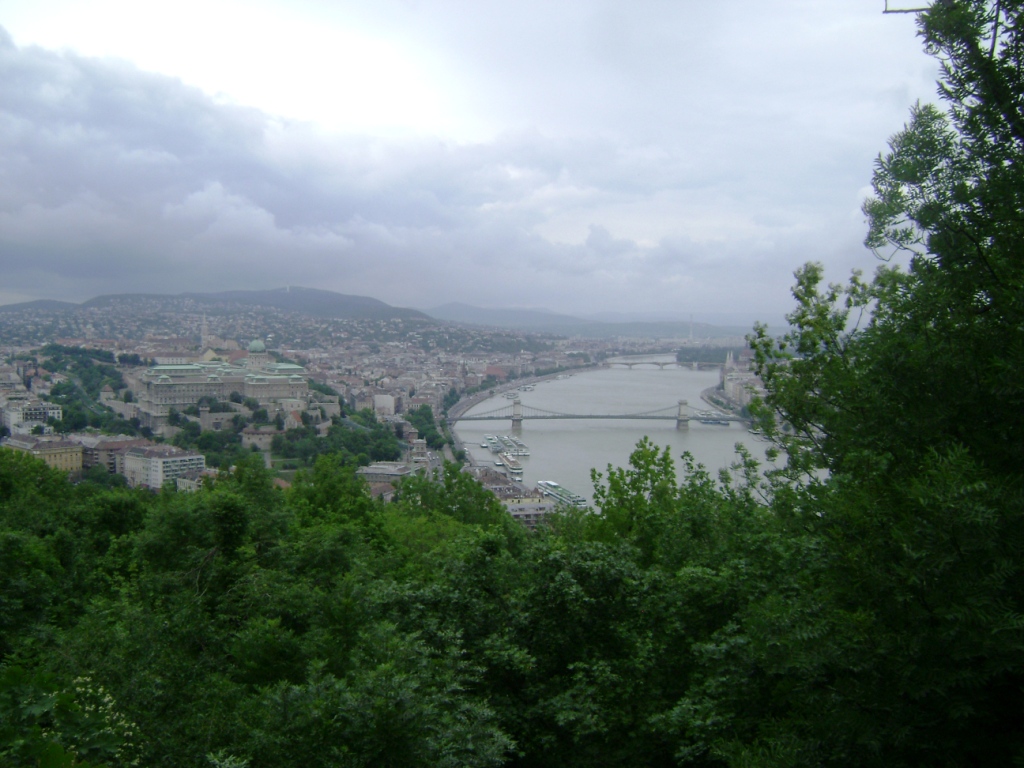
It was a dark and stormy night in the city by the Danube. We (Jeanne, Jane and Gail)  have consumed bowls of goulosh and toured the city.  We are trying to answer the enduring question: Can a semi efficient socialist economy transition into a functional and vibrant capitalist system? Our quest began on the "Hop Off, Hop On" city bus tour.  A notable start to the day's travels took us through Castel Hill, where I lived 29 years ago.  We crossed the river and hopped off in central Pest (the other side of the river from Buda), successfully purchased train tickets to Romania, ate soup under the shadow of St. Stephen's Basilka, had glorious gelato and then prepared to hop back on.  Waited for the Yellow Bus.  Noted that traffic and trams were not moving.  Queries revealed that traffic was snarled because the taxi drivers were demonstrating in the heart of the city.  The taxi industry was privitzed when the economic transition occurred.  Now, a number of years later, the tourism ministry has decided that things were running better the way the taxi sytem was in the bad old days.  The proposal is to return to centralization.  No Yellow Bus.

When the Yellow Bus arrived, it was Red.  We tourists ran, as a group of cattle, to meet it; then drove around the square 3 times waiting to catch up with ourselves and the delayed bus schedule.  Finally got on the open second story of the bus, thunder cracked, rain pelleted; we headed down below.  Bus began leaking copiously.  Tourists tried to catch leaks in empty water bottles.  Finally made it back to to our stop, missing the last cruise on the Danube by about an hour.  I have begun to suspect that the system has transitioned from semi efficient socialism to inefficient capitalism.
                                                      Jeanne